


بسم الله الرحمن الرحيم
Throughout October 2026, Hizb ut Tahrir / Wilayah Sudan focused its efforts on exposing the illegitimacy of the current regime in Sudan. Domestically, the regime implements non-Islamic laws that have brought poverty and misery upon the people. Internationally, it submits to international law, leaving the country vulnerable to colonial interference and malicious conspiracies aimed at fragmenting the nation. Consequently, the interests of the Sudanese people are now exposed to grave dangers; even agent states—such as Ethiopia—have dared to declare war on Sudan, while the government remains in a deep slumber.
The members of Hizb ut Tahrir / Wilayah Sudan are working diligently to expose these nefarious actions by clarifying the rulings of Islamic Sharia, which offer the only correct solutions. They call upon the people of Sudan to join them in their efforts to establish Islam within the state and society. Here are some of the activities:
The Office of the Official Spokesperson for Hizb ut Tahrir in the Wilayah of Sudan:
Ibrahim Othman (Abu Khalil), the Official Spokesperson for Hizb ut Tahrir in the Wilayah of Sudan, has consistently addressed the crimes committed against the people of Sudan. He issues a series of statements outlining the position required by Islamic Sharia for the Ummah to take in confronting these crimes and conspiracies. For instance, following the killing of dozens of miners in renewed airstrikes near the colonial-era border between Sudan and Egypt—carried out by Egyptian warplanes while the Sudanese authorities remained silent—Abu Khalil stated: "Let the rulers of Egypt and Sudan know that the blood of a Muslim is far too sacred in the sight of Allah to be violated in such a heinous manner. The Prophet (saw) said: «لَزَوَالُ الدُّنْيَا أَهْوَنُ عِنْدَ اللَّهِ مِنْ قَتْلِ مُؤْمِنٍ بِغَيْرِ حَقٍّ» 'The destruction of the entire world is less significant to Allah than the unjust killing of a believer.'" He further added: "Know, O rulers of Egypt and Sudan, that even if you manage to evade accountability before the Khilafah (Caliphate) state—which will soon return, by the permission of Allah—you will not escape the punishment of Allah, the Avenger, the All-Mighty; on a Day when excuses will be of no avail to the wrongdoers." In a press conference held at his office in Port Sudan, he revealed that the United States is neither an honest broker nor genuinely interested in establishing peace in Sudan. Instead, it maintains a grip on the Sudanese conflict to serve its own interests—equating the state’s official army with a separatist, insurgent armed force that seeks to detach Darfur from Sudan. He asserted that the U.S. is orchestrating the war from behind the scenes, describing it as an American conspiracy, and emphasized that this intervention is aimed at carving Darfur away from the rest of the country.
Delegations to Sudanese Notables:
A delegation led by Dr. Ahmed Abdel-Fadil, a member of the Hizb ut Tahrir Council in the Wilayah (province) of Sudan, visited Emir Awad al-Jayyid al-Na’ima, the Emir of the Kawahla tribe in Khartoum. During a gathering that included a significant number of notables, emirs, and tribal leaders, Emir Muhammad Zain (Abu Hafs) introduced Dr. Ahmed and the delegation to those present. Dr. Ahmed explained that the party’s delegation had come to stand in solidarity with the Emir upon hearing the news of his arrest—noting that they had also visited him at his home two weeks prior. He emphasized that the Emir’s stances, rooted in Islam and undertaken for the sake of Allah, compel them to stand firmly by his side; for a Muslim is the brother of a Muslim, and it is Islam that binds them all together.
In their remarks, the emirs and notables affirmed the importance of Islam and a return to it, asserting that it is the only solution to rescue the country from its current plight and to reform the state of the Ummah and its people. The visit was well-received by the Emir and the notables alike.
Issues of the Ummah Forums:
The Media Office of Hizb ut Tahrir in the Wilayah of Sudan held its recurring Issues of the Ummah Forum in the city of Port Sudan, under the title: "Guidelines for the Sudanese Dialogue: Entrenching Disbelief and Repeating Failed Experiments." In the first presentation, Ustaadh Abu Khalil examined these guidelines, focusing on three issues raised by the dialogue committee: democracy, identity, and decentralized governance. He analyzed each of these points in detail, further arguing that the various separatist insurgencies were not caused by the centralized governance—which the committee rejects—but rather by the corruption of the regimes and international power struggles within Sudan. In the second paper, Yaqub Ibrahim addressed the Sharia rulings pertaining to governance, explaining that the system of rule in Islam is the Khilafah (Caliphate). He presented evidence demonstrating that a Muslim’s identity is defined by Islam, and concluded by noting that while governance in Islam is centralized, administration is decentralized—meaning it is not a federal system, as is the case in the flawed democratic paradigm.
Political Forum Critiques the Capitalist Economic System
The Media Office of Hizb ut Tahrir in the Wilayah of Sudan hosted Ustaadh Yaqoub Ibrahim, a member of Hizb ut Tahrir, at a political forum titled: "The Capitalist System Creates Crises; There Is No Way Out Except Through Islam." Ust. Yaqoub began by discussing the current situation in several European countries—most notably France—where protests have erupted over living conditions and the state of education. He argued that this underscores the inherent flaws of the capitalist system, which generates crises even within the very nations that champion it. He explained that the fundamental defect of capitalism lies in its economic vision, which focuses exclusively on the production of wealth while disregarding its distribution. Furthermore, its sole reliance on private ownership has been a primary driver of recurring crises and the failure of governments.
He then highlighted that the Islamic economic system prioritizes the distribution of wealth, thereby addressing the problem of individual poverty. Islam recognizes various forms of ownership—private, public, and state—all of which are regulated by Shariah provisions, ensuring that no single form of ownership encroaches upon the others. He concluded by noting that the Islamic economic system can only be implemented within the framework of the Islamic system and its state: the Khilafah Rashidah (rightly guided Caliphate) established upon the methodology of the Prophethood.
Political Addresses
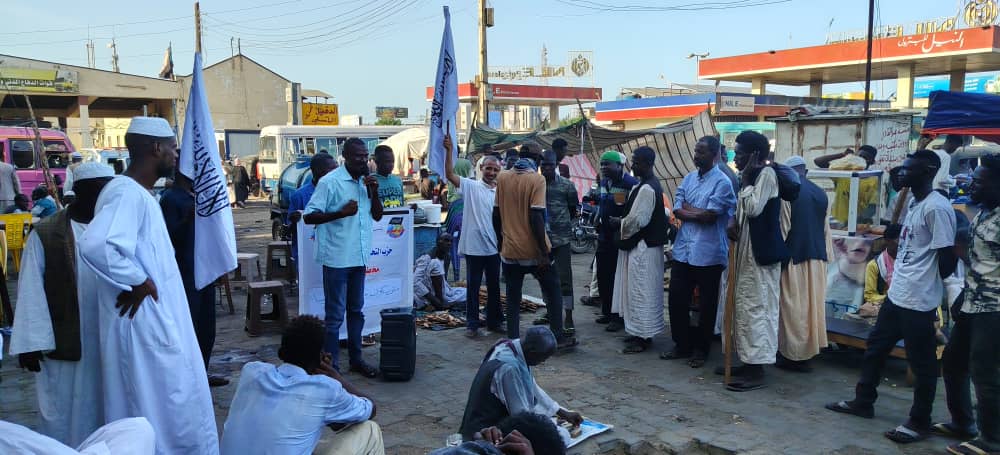
Throughout this month, speakers in various political addresses covered a range of topics under diverse themes. Ibrahim Musharraf discussed the concept of identity, asserting that the people of Sudan are Muslims. He argued that the kufr (disbelieving) West—along with its internal proxies—is attempting to impose new, alternative identities—national, tribal, and regional—in an effort to sow doubt among Muslims regarding their true identity. He highlighted the dangers of the "national identities" promoted by politicians in our country, explaining that their purpose is to fragment the unity of the Ummah and incite internal conflict. He further emphasized that Islam alone is what can unite the Ummah and forge its people into a single, cohesive entity.
In another address, delivered on Monday, the 1st of Jumada al-Awwal 1448 AH, Yaqub Ibrahim spoke about the human need for a dignified life. He noted that Islam guarantees such a life by encouraging labor and economic activity. He condemned the state’s harassment of workers in marketplaces, as well as the killing of individuals in mining areas—citing, for instance, incidents that have occurred along the arbitrary, artificial border between Sudan and Egypt.
In a political address titled "And Allah has more right that you should fear Him," Adel Ibrahim underscored the importance of working for the sake of Islam and striving to establish its governance within a state. He acknowledged that such an endeavor may entail significant risks—including economic hardship, the persecution of those involved in the work, and attempts by adversaries to prevent Islam from manifesting as a state system. He asserted that the enemy, regardless of how formidable they may appear, is inherently weak and does not deserve to be feared by Muslims. He pointed out that even Iran—despite its distance from the true application of Islam—has managed to humble the United States; one can only imagine, then, what might be achieved if Muslims were to establish their own state—the Caliphate—and confront their enemies under the banner of Islam. In an address delivered during the last week of October, Ust. Hussein Al-Hadi detailed the various forms of suffering endured by the people of Sudan—most notably the difficulty in obtaining basic sustenance and other essential needs required for a dignified life—while noting that no one is taking responsibility for providing these necessities. He explained that the root cause is the absence of the Divine system, which is designed to secure the fundamental needs of the people.
These events were very well received; attendees participated by offering comments and affirming that the only way forward is the establishment of the Khilafah Rashidah (rightly-guided Caliphate) upon the methodology of the Prophethood.
Saturday, 20 Jummadah al-Awwal 1448 AH corresponding to 31 October 2026 CE

Click to open image!


https://hizb-ut-tahrir.info/en/index.php/dawah/sudan/30641.html#sigProIdc0430171ac
More Details, Visit Websites of Hizb ut Tahrir / Wilayah Sudan
Official site: Hizb ut Tahrir / Wilayah Sudan
Facebook: Hizb ut Tahrir / Wilayah Sudan
Youtube: Hizb ut Tahrir / Wilayah Sudan